
Réseau de surveillance volontaire des lacs (RSVL)
Contact us (French)
RSVL (Overview)
( PDF,
571 kb)
PDF,
571 kb)
RELAIS - Online Service (For existing RSVL lake monitoring participants)
Location of participating lakes
(French,
PDF, 1.1 Mb)
Methods used to assess lake trophic status
Water quality results (French)
Folder
(French,
PDF, 293 kb)
Application to join
the RSVL network
(French)
(Check if your lake meets the eligibility criteria listed on the left before registering)
Useful links
Water Atlas - Lakes
(French)  .
.
Blue-green algae = cyanobacteria! (French)
Objectives
Together with its partners, the Réseau de surveillance volontaire des lacs pursues the following objectives:
- Acquire data to determine the trophic level of a large number lakes and monitor their evolution over time;
-
Identify lakes showing signs of eutrophication and degradation;
- Educate, increase awareness, support and inform lake associations and other participants;
- Provide an overview of the state of Québec’s recreational lakes.
Eligibility criteria
Certain eligibility criteria have been established to ensure that the water bodies listed in the RSVL meet the definition of a lake. The objective is to immediately exclude ponds and other wetlands for which the proposed monitoring would be less relevant.
To be eligible for the RSVL, a lake should, in the vast majority of cases, have the following characteristics:
- Have a depth of at least three metres or that allows for measuring water transparency in a representative way. The Secchi disk should not systematically rest on the bottom of the lake when taking measurements;
- Have a surface area of at least five hectares (0.05 km2). However, some smaller lakes could qualify if their depth is sufficient to measure transparency;
- Be of natural origin. A lake formed as a result of human intervention is artificial and would not be eligible;
- Be free of aquatic plants on the surface of over 50% of its area. This criterion applies especially to small lakes;
- Be located near dwellings or frequented on a regular basis (vacation lake);
- Be supplied by at least one watercourse (tributary) or by underground sources and drain through at least one outlet (watercourse discharging the water from a lake).
You have until February 15 of each year to register a lake for the RSVL and be assured that the application can be assessed for the current year’s sampling season. Applications filed after February 15 will be considered for the following year.
Note that, in exceptional cases, some water bodies might not meet all the criteria but may still be eligible for the RSVL. Write to rsvl@environnement.gouv.qc.ca if you have questions about the eligibility of a body of water.
Costs
To support lake monitoring and protection, the Ministère covers 75% of RSVL costs
(French, PDF, 2.2 MB)
As a result, it currently costs $135 per station for laboratory analysis, instead of $540. In addition to the cost of analyzing three water samples per station, this amount includes shipping costs and taxes. For new network members, an additional $75 is required to purchase a Secchi disc to measure water transparency. Please note that these prices are subject to change without notice.
No charges are incurred for years when participants only monitor water clarity.
Sharing of responsibilities
- Coordinates and supervises the Program
- Supports lake association members
- Analyzes the data and communicates the results
- Develops supporting tools and documents
- Teams with local partners to support lake association members
- Collects water samples
- Makes measurements and observations in the field using the provided protocols
For optimal results, participants who register a lake should commit to a long-term monitoring effort.
Monitoring activities
- Water quality is monitored by:
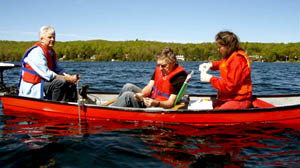
- measuring water transparency (Secchi disk depth);
-
collecting water samples for laboratory measurements of phosphorus, dissolved organic carbon and chlorophyll a. All water analyses are performed by the Ministère’s laboratory, the Centre d’expertise en analyse environnementale du Québec (CEAEQ).
Transparency measurements and water samples are taken at a station generally located in the deepest part of the lake. For a very large lake, more than one station may be needed.
- In addition to water quality measurements procedures, participants are also provided with protocols to assess state of the riparian strip and littoral zone.
Water quality monitoring: What is involved?
Water transparency
-
Using a Secchi disk, water transparency should be measured every two weeks, from the beginning of June to the beginning of October, on an annual basis.
Water transparency is an easy and inexpensive measure that can reveal long-term changes in water quality and the general state of the lake.
Water sampling
-
The basic water monitoring program was modified in 2010. The program now involves sampling for two or three consecutive years, in June, July and August. A pause of four years is taken before sampling resumes.
For example, if the last sampling took place in 2010, sampling would resume in 2015 after a four-year break.
This monitoring plan is designed to achieve greater precision in estimating average concentrations of the water quality variables used to evaluate the lake’s trophic level.
The approach taken by the RSVL is to evaluate the precision obtained for each lake after a two-year monitoring period. Depending on the results, an optional third year of sampling may be suggested to the participants to improve precision. However, a participant may choose right from the start to sample for two or three consecutive years. After each additional year of sampling, precision of the mean concentration estimates will be recalculated. For lakes displaying a high variability, RSVL specialists could recommend that the number of samples taken annually be increased to improve precision.
The RSVL program is getting better with time
Analyses of the data collected since 2004 have revealed that in order to account for normal variations in water quality over the course of a summer and from year to year, the best monitoring strategy for the RSVL is to sample over several consecutive years. This allows obtaining enough data for average concentrations to be calculated with acceptable precision, while holding down the expense of laboratory analyses.
How many years of monitoring are required to obtain sufficient precision? This varies from lake to lake and from one water quality variable to another. Without being a stringent constraint, the total phosphorus parameter objective is to achieve a margin of error of within 20% of average value.
Protocols and support documents
- Detection of invasive exotic aquatic plants
-
Assessment of lake bacteriological water quality
(French, PDF, 1,4 MB)
- Periphyton monitoring
(French, PDF, 2,4 MB)
-
Support document for the Periphyton monitoring protocol
(French, PDF, 2 MB)
-
Field Card (French, PDF, 349
KB)
-
Support document for the Periphyton monitoring protocol
(French,
- Visual
monitoring for blue-green algae blooms (French, PDF, 2 MB)
-
Categories of blue-green algae blooms (French, PDF, 322
KB)
-
Field card (French,
PDF,
204 KB)
-
Categories of blue-green algae blooms (French,
-
Water quality sampling
(PDF,
1 MB)
Field card(
PDF, 299 KB)
English versions available upon request.
-
Planning inventories (riparian strips and littoral zones) (French,
PDF, 539
KB)
-
Riparian strip characterization
(French, PDF, 2,2 MB)
-
Field card (French,
PDF, 1.5 MB)
-
-
Support document for the riparian strip characterization protocol (French,
PDF, 3,9 MB) - Tool for compiling data and presenting results from the riparian strip
characterization protocol:
- Instructions
(French, PDF, 601
KB)
- Spreadsheet (French,
 Excel, 3 MB)
- Instructions
(French,
- Water
transparency measuring (PDF,
418 KB)
- Why measure water transparency on a regular basis?
- Field card (PDF, 295 KB)
-
Data Collection Form – Transparency (PDF,
131 KB)
- Making
a homemade aquascope (French,
PDF, 1.1 MB)
- Making a double-headed rake to sample submersed aquatic plants
(French,
PDF, 738 kb)
RELAIS - Online Service
RELAIS is an online service that allows RSVL participants to access their files, enter and/or change information and dialogue with RSVL managers at the Ministère.