
Wood heating
In Québec, residential wood heating is the main cause of poor air quality (French) in winter. When wood is burned in a stove, fireplace or campfire, significant amounts of air contaminants are generated, including carbon monoxide (CO), volatile organic compounds (VOCs), fine particulate matter (PM2,5), black carbon (BC), nitrogen oxides (NOx) and polycyclic aromatic hydrocarbons (PAH).
For additional information on contaminants, see the section on Air Contaminants (French).
In neighbourhoods where wood heating is widely used, exposure to contaminants from wood-burning appliances can have harmful effects on people’s health (French) , including:
- nausea
- dizziness
- headaches
- eye, nose and throat irritation
- worsening of asthma and other respiratory problems
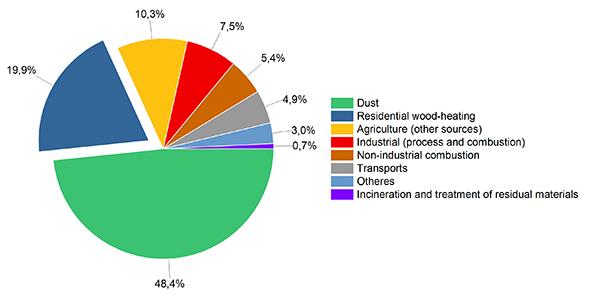
Residential wood heating is responsible for 19.9% of fine particulate matter emissions (French,  PDF, 11,8 MB) generated by human activity. It is the main source of fine particulate matter emissions in winter. Data from Natural Resources Canada show that the regulations adopted over the years have had an impact, since the number of homes using wood heating has decreased since 2000.
Breakdown of fine particle emissions in Québec in 2020
The Regulation respecting wood-burning appliances (French), passed in 2009, prohibits the manufacturing, sale and distribution, in Québec, of wood-heating appliances that do not comply with the environmental standards of the Canadian Standards Association or the United States Environmental Protection Agency.
Some municipalities have also passed their own by-laws regulating wood heating within their territory. Ask your municipality about this before installing a wood-burning appliance in your home.
Impacts on air quality: fine particulate matter
Wood heating is a major source of fine particulate matter. Its presence in the air is monitored by the Réseau de surveillance de la qualité de l’air du Québec (French) (Québec’s air quality monitoring network) and its impacts can be seen at most of the network’s urban stations.
Hourly concentrations of fine particles in winter from 2019 to 2021
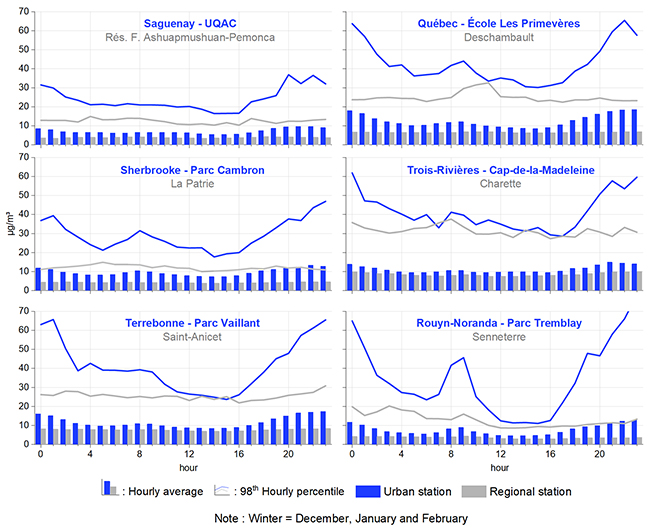
In winter, fine particulate matter concentrations fluctuate according to the time of day, with two peak periods. The first peak, of slightly lower intensity, occurs in the morning when households add wood to their stoves before leaving for work. The second occurs in the evening, when households restart their stoves and keep them burning until bedtime. This peak lasts for longer, because wind intensity tends to decline during the evening, preventing contaminants from being dispersed (French) into the air and causing them to concentrate at ground level instead.
These variations are not observed at rural stations, clearly showing that the peaks in urban areas are caused by local human activity. Given the time at which the highest concentrations occur, i.e. late evening, it is reasonable to conclude that wood heating is responsible.
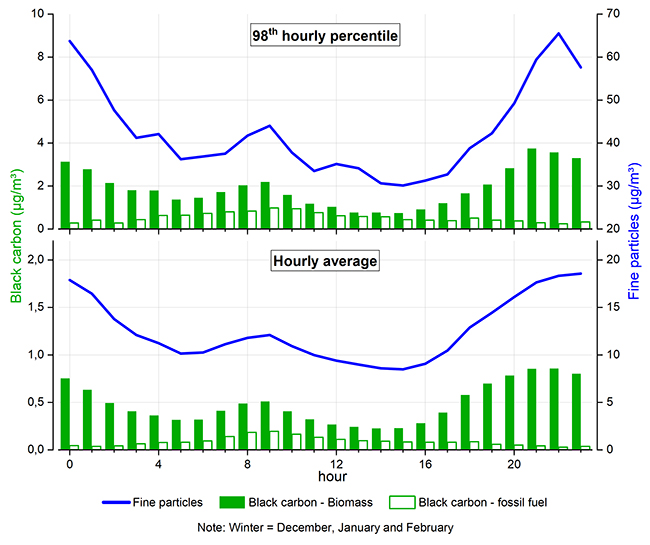
Monitoring of black carbon concentrations also tends to show that wood heating is the main cause of high concentrations of fine particulate matter in winter. Black carbon is one of the components of the fine particulate matter emitted when wood is burned. It is possible to distinguish between black carbons emitted by biomass combustion (wood heating) and by fossil fuel combustion (road transportation). In winter, hourly concentrations of black carbon produced from biomass mirror those of fine particulate matter in general, but not those of black carbon produced from fossil fuels.
Hourly concentrations of fine particles and black carbon in winter at the Québec – École Les Primevères station from 2019 to 2021
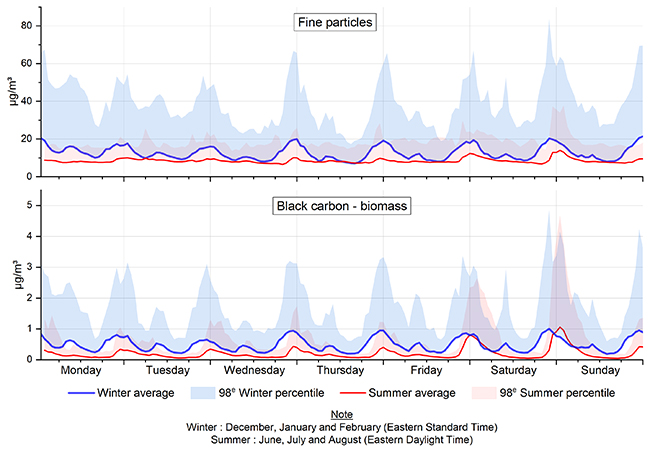
Wood heating causes concentrations of fine particulate matter to increase, regardless of the day of the week. However, the increases tend to be greater on weekends, especially Saturday and Sunday evenings. This is probably due to occasional use of wood-burning fireplaces by households. Comparisons of summer and winter data reveal the significant contribution made by wood heating to fine particulate matter concentrations in winter. Concentrations also increase to some extent in summer, probably as a result of outdoor backyard fires.
Hourly concentrations of fine particles and black carbon (biomass) on a weekly basis in winter and summer at the Québec – École Les Primevères station from 2019 to 2021
Good wood heating practices
To reduce your exposure to contaminants:
- Do not use wood heating as the main source of heat in your home.
- Limit the use of wood-burning fireplaces and stoves when smog warnings (French) are in force.
- If outdoor fires are permitted, limit their use (campfire, burning of leaves, etc.).
When you heat with wood:
- Where available, use hardwoods such as oak, maple or birch instead of softwoods such as fir, pine or spruce, and choose seasoned logs that have dried for at least six months.
- Comply with regulations (French), prohibiting the burning of materials such as plastic, treated wood or painted wood in domestic heating appliances.
If you are thinking of buying a wood-burning stove or fireplace:
- Make sure the appliance is sized correctly for your needs, and do not buy one with a heating capacity that is too large for your space.
- Opt for an electric stove or fireplace instead. Some models can be installed in existing appliances.
- Consult your municipality; some cities may regulate the installation or use of wood-burning appliances.
- Maintain, repair or replace your wood-burning appliance when necessary. Over time, a wood-burning appliance and its chimney may develop leaks through which gases and particulate matter can escape. In addition to reducing the appliance’s energy performance, these leaks can diminish air quality in your home. Regular chimney cleaning is needed, not only to ensure that the wood is burned efficiently, but also to minimize the risk of chimney fires.
- Buy a certified appliance that complies with the Regulation respecting wood-burning appliances (French), with the lowest possible particulate emission specifications. Pellet-burning fireplaces and stoves control the burning process and generally produce fewer pollutant emissions than ordinary wood-burning appliances.
- Comply with the Canadian code of practice for residential wood-burning appliances: proper installation is safer and will ensure the appliance works properly.
For additional information
- Heating with wood - Ville de Montréal (French)
- Stoves and fireplaces - Ville de Québec (French)
- Preventing the health effects of air pollution (French) - Québec.ca
- Wood heating - Santé Montréal (French)
- United States Environmental Protection Agency - Burn Wise